I finished 48 books in 2025. I’m still waiting for my applause or Free Tote, but honestly I think the virtues of reading might be oversold. Literacy is important, even necessary for survival, and reading seems a healthy habit for brain function, yes uh-huh, but I acknowledge what follows as nerd shit. No nobler a hobby than weightlifting for some. The only people who should feel any real pressure to weightlift are people who plan on saving someone pinned under a heavy object; same goes for those who plan to write (well).
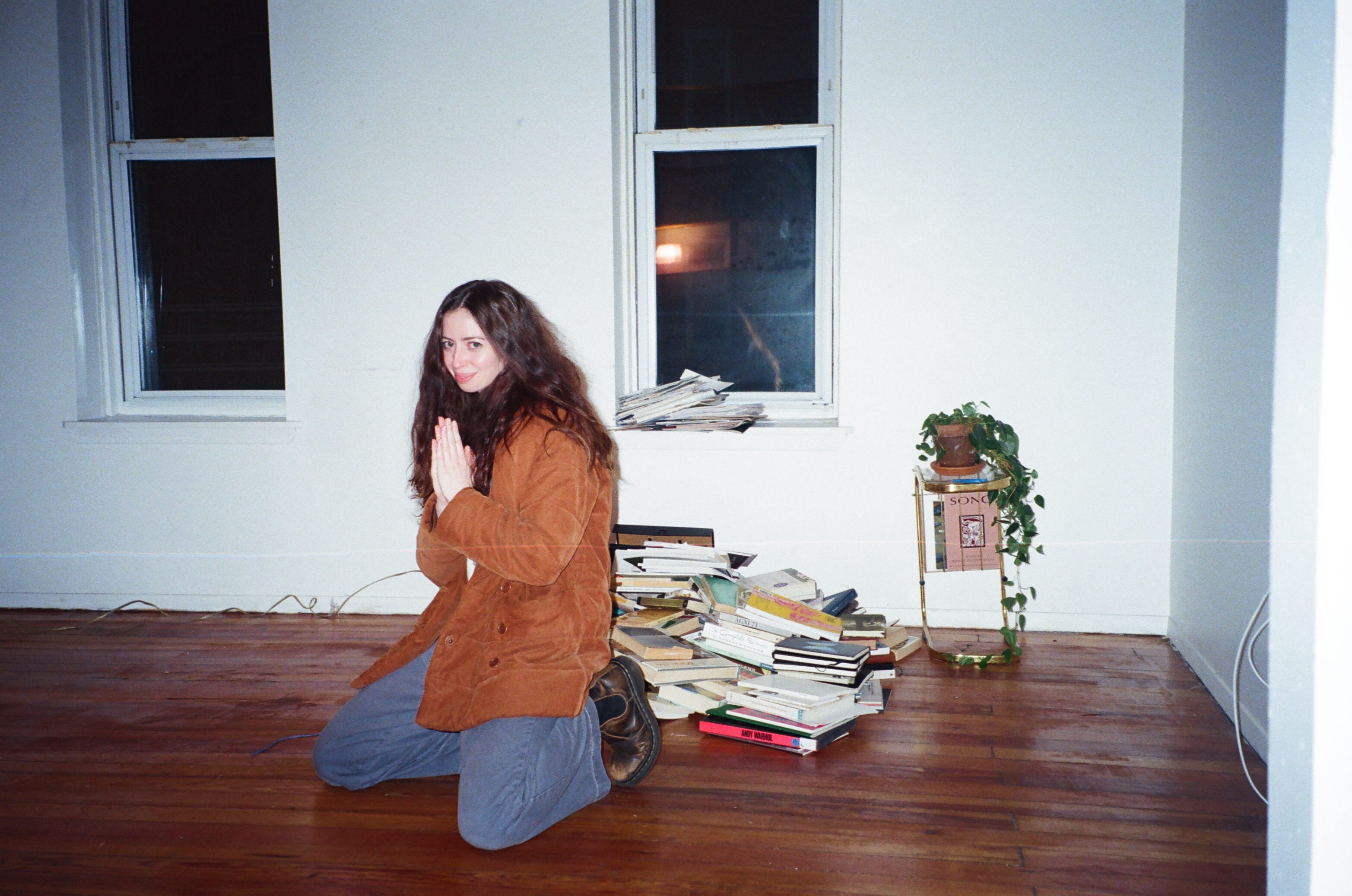
This is what my living quarters look like
I did not set foot in a gym last year, and other than that I can attribute my increased stats to spending an average of two hours/day on the subway and my coming around to audiobooks. Audio might not scratch quite the same itch as flicking my eyeballs back and forth, but some books were heaven to hear aloud while I conducted my everyday life sans dishwasher, laundry machine, car, or job that requires actual concentration.
What made 2025 a good year in reading for me was not so much volume but quality. Last year I went against my instincts by letting most of my choices be guided by other people, who in fact recommend or fling books at me all the time. I was surprised to find many new favorites by simply committing to reading these, plus the extra pleasure of babbling with someone about it later. I read much more than I bought by borrowing often from friends and lovers and libraries. My reading peers made me feel seen! There were few books I disliked and you’ll only find some venom towards the bottom.
I set out to rank what I read last year because doing so feels somewhat unnatural and pointless and therefore difficult for me; what I found by forcing myself to do that (while sketching out each rank’s rationale) is a small improvement in my understanding of my own taste. I knew that what I liked skewed more “literary” than “commercial,”1 more towards novels and poetry than much else, and could name a few vague trends related to geographic origin or time period. Now, because I branched out a little more last year and based my ranks purely on emotion (rather than my best guess at objective quality), I understand better what sort of reading experience makes any book feel valuable to me. The titles below ended up falling into rough categories, which are ultimately less arbitrary than the exact sequence within. In descending order: changed by, beloved, fond of, ambivalent towards, frustrated by. Books that I felt influenced my writing rose toward the top; those I struggled to remember much of fell farther down.
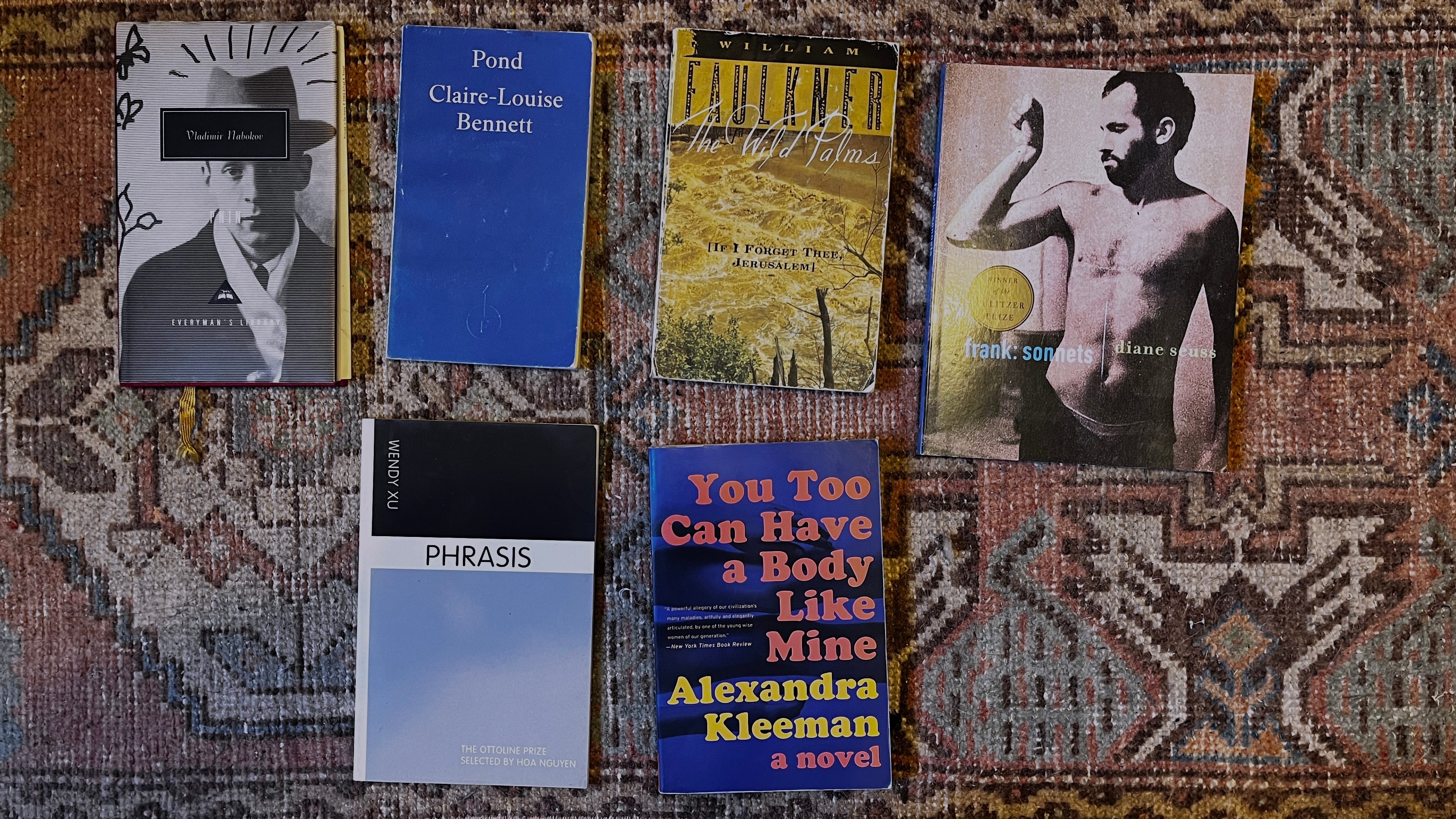
A few winners I have copies of right now
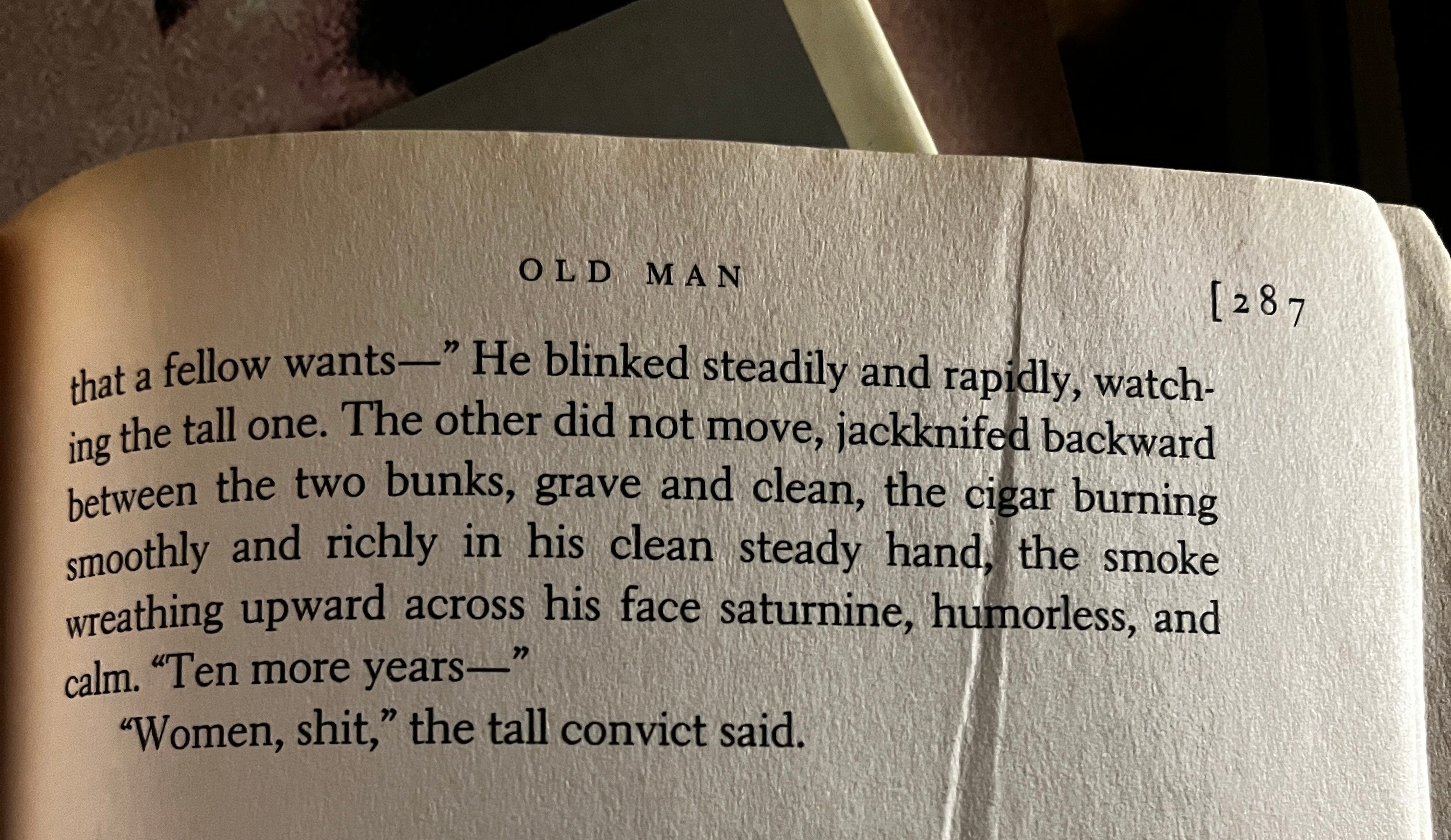
Without further ado, I offer my judgments up to your judgment (illuminated by any pictures I took of their pages last year):
The Wild Palms/If I Forget Thee, Jerusalem, William Faulkner — 1939 Novel
Gifted by a classmate clued into my current obsession with Great Floods and love for Faulkner, now not only book of my year but a book of my Life. Nothing like those sentences flowing on and on and on across pages. Rapturous passages. Something immortal in the struggle of Charlotte and Wilbourne to grade work (for survival) against time (for love). Combines two of the most fucked-up stories I’ve ever read and thought were actually worth it. The earlier New-Wave-famous quote aside, my favorite last line of any book yet. A strong recommendation to folks interested in Faulkner but turned off by his typical Modernist blur or looking for a more propulsive narrative.
The Master Letters, Lucie Brock-Broido — 1995 Poetry col.
Bought new, toted everywhere, read to tatters, then loaned this amply-underlined and flood-damaged copy to my anonymous master (of course never to be seen again). LBB has been a touchstone contemporary poet for me since I read Stay, Illusion last summer, and one who I believe maintains a singular voice even as she riffs off of the mysterious letters of Emily Dickinson and her half-fictive addressee...anyway I won’t bore you with explaining why I think LBB herself is a master, but I’ll say that this particular project of hers read my Poor Subordinate heart to filth. Will be another lifelong favorite.
Modern Love, Constance De Jong — 1974 Novel
Arrived as mail surprise thanks to a friend at Asterism, whose accurate instincts told her I’d like it (“Constance De Jong is the straight woman’s Eileen Myles,” direct quote). Never read a book structured quite like this, to a certain degree of associative freedom, with scrappy, exuberant intellect stitching together all sorts of genres. CDJ’s speechlike inflections stick in my head like nothing else. First book I’d read in a while that made me want to write fiction…even through all of its disjointed digressions it remains a 10/10 in all categories for me.
You Too Can Have a Body Like Mine, Alexandra Kleeman— 2015 Novel
A specifically-requested Christmas gift last year, on recommendation from a poetry mentor who thought it touched on concerns for “Deepfake” re: synthetic doubles. Indeed! I not only felt like this book stands out in a sea of middling 20-teens literary fiction (who else was writing this sort of late-stage capitalist absurdist gimmicky satire?), but also as if it was written just for me. A book that saw into my soul, and at once filled me with urgency to write a novel and a sense of defeat that it could never be this one. I went on to read Kleeman’s other novel not long after, which too satisfied (see #13).
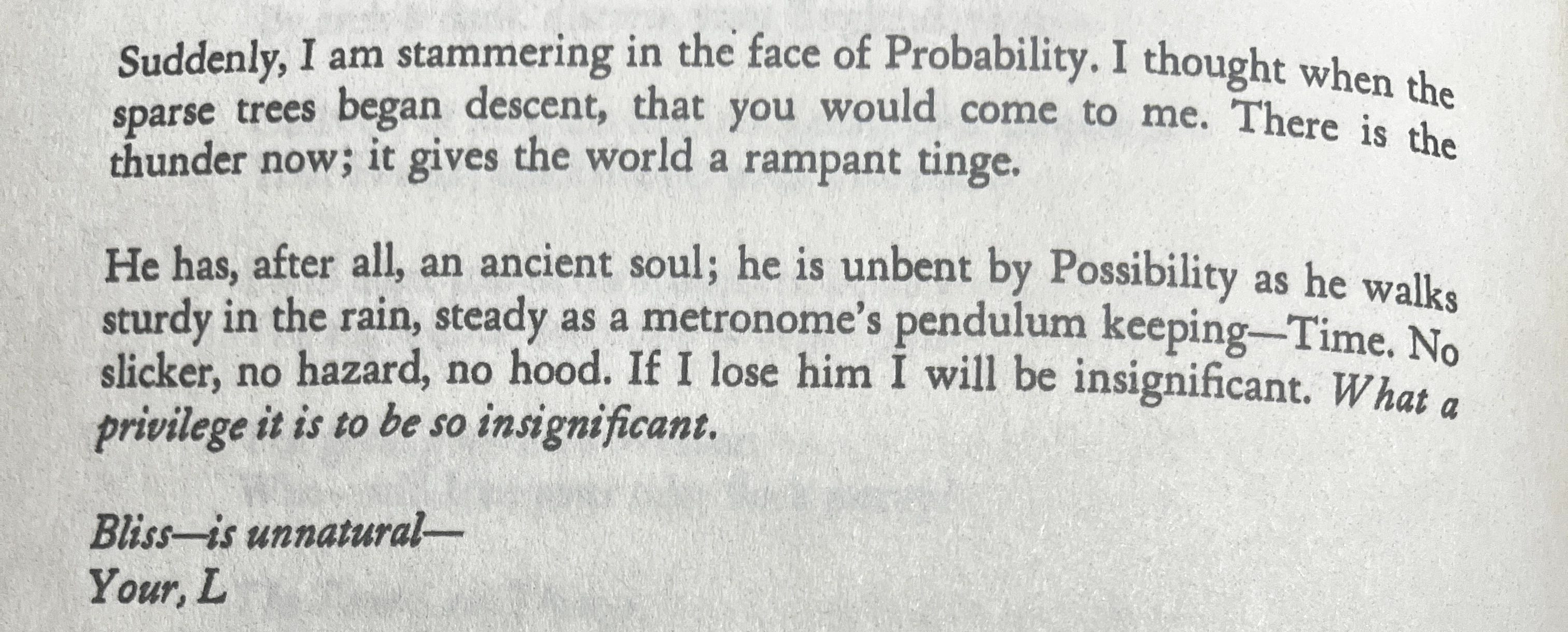
Pond, Claire Louise-Bennett — 2015 Story col.
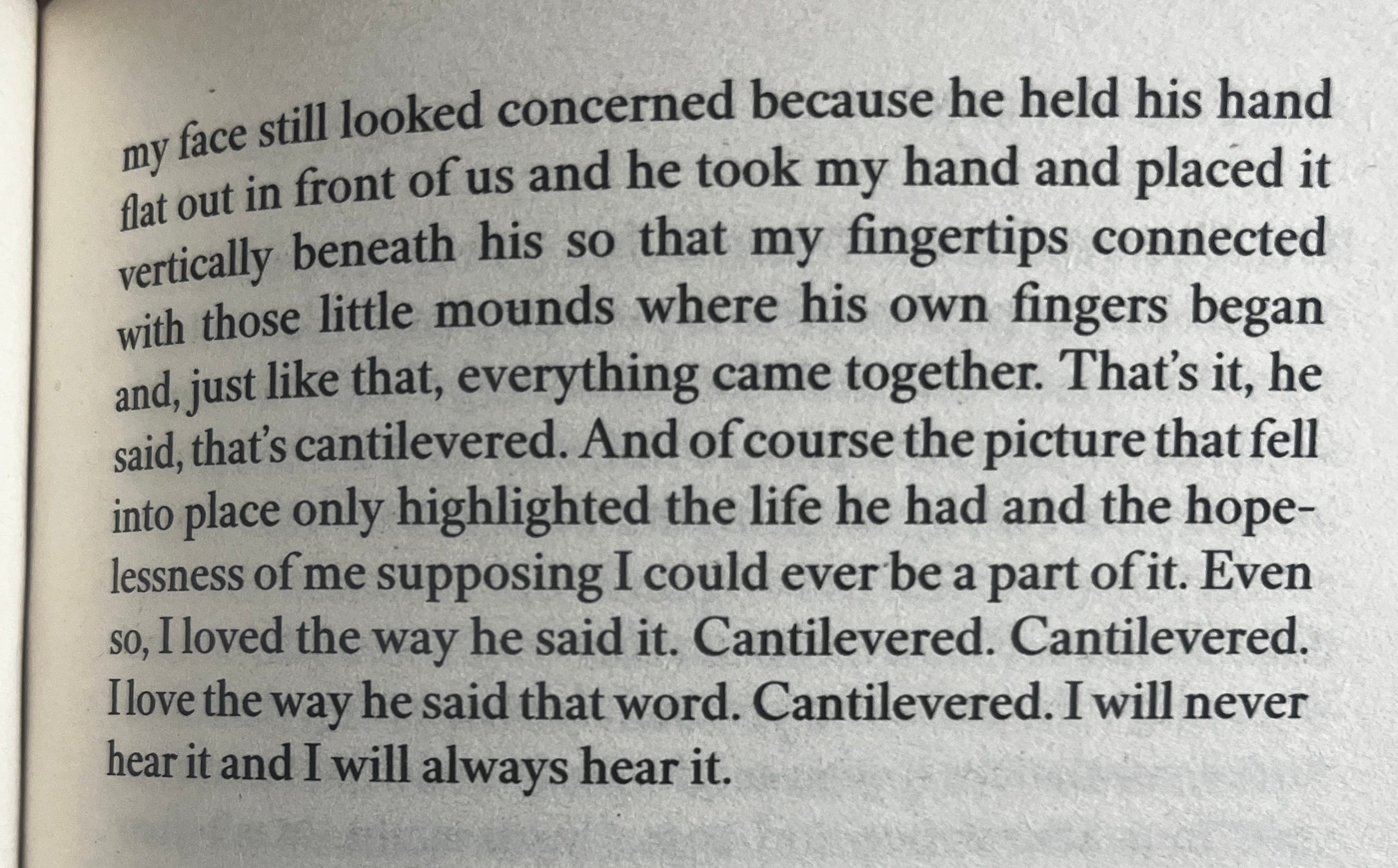
Recommended by three different friends and then gifted by the same heroic donor of #1, it too made me feel oddlyunderstood by my reading peers. Read after Checkout 19 (which ranked #41), at last earning my full faith in CLB as a genius, tastemaker, voice of her generation, etc. Essential reading for anyone leading the Lyric Life. I think about the end of the “The Deepest Sea” chapter often:
Frank: Sonnets, Diane Seuss — 2021 Poetry col.
Loaned by a classmate and included for me in the category of life-changing poetry collections. Furious that I was so late to the game (three years post-Pulitzer!), but I think this book impossible to read without succumbing to the influence of DS’s voice and also impossible to read without wanting to re-read (and no, not in bits and pieces, but all the way through again because it’s a memoir). Would demand that even a poetry-hater read it before they die.
Pnin, Vladimir Nabokov — 1957 Novel
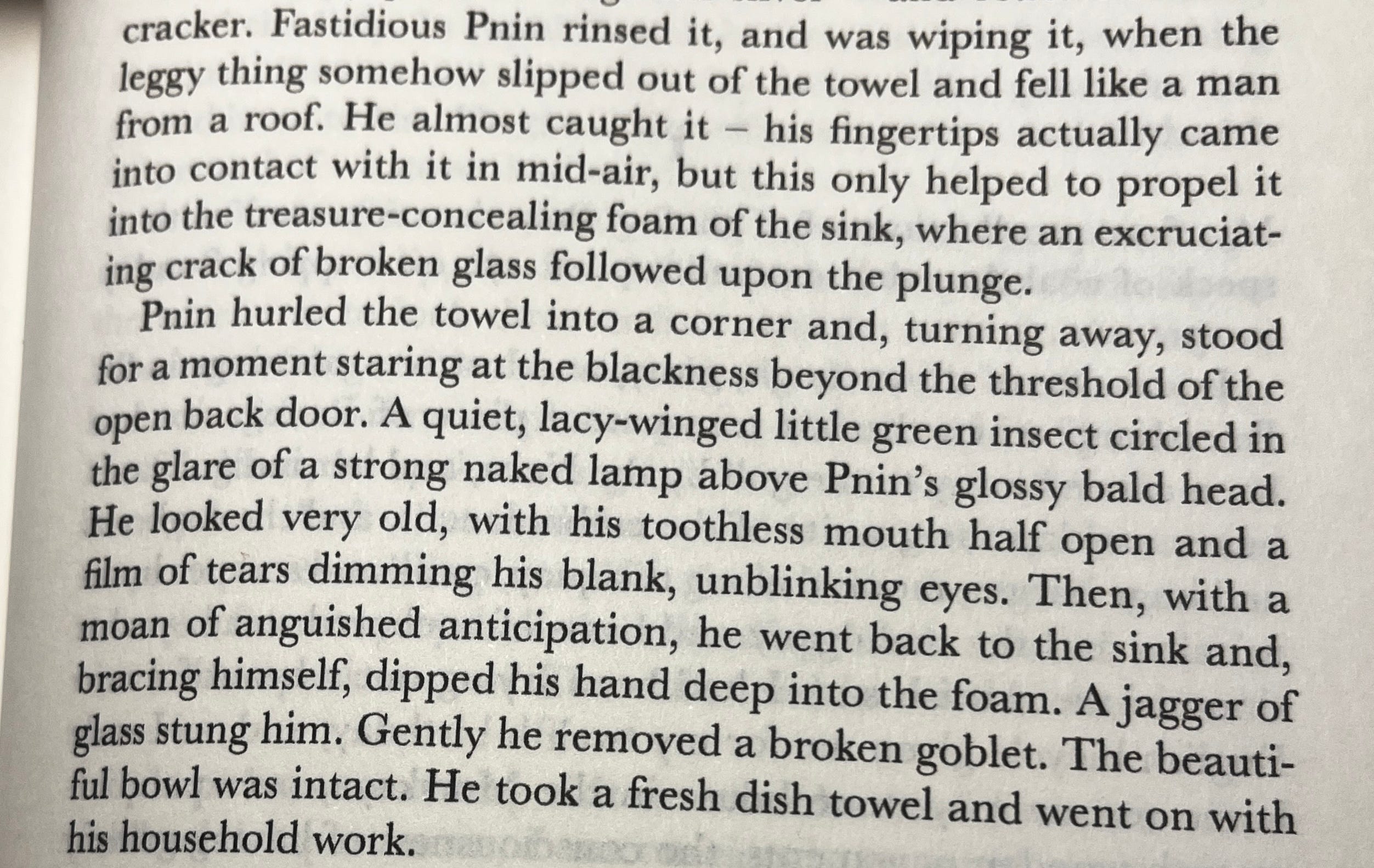
A re-read of one of my favorite books from my own shelf, and although I hadn’t read it in six years, I’ll admit this is a bit of a cheat since VN doesn’t miss for me. Yes, for his absurd poet’s style, but also for his conceptual and structural feats: in Pnin it’s character-versus-narrator, where VN figured out a way to have the book’s eponymous figure buck against the one writing him. Never stopped thinking about how he pulls that off. The incredible tenderness of the book I’d forgotten, which made this book feel like it saved me as the very last read to close a difficult year. Fuck my Pninian life.
iykyk
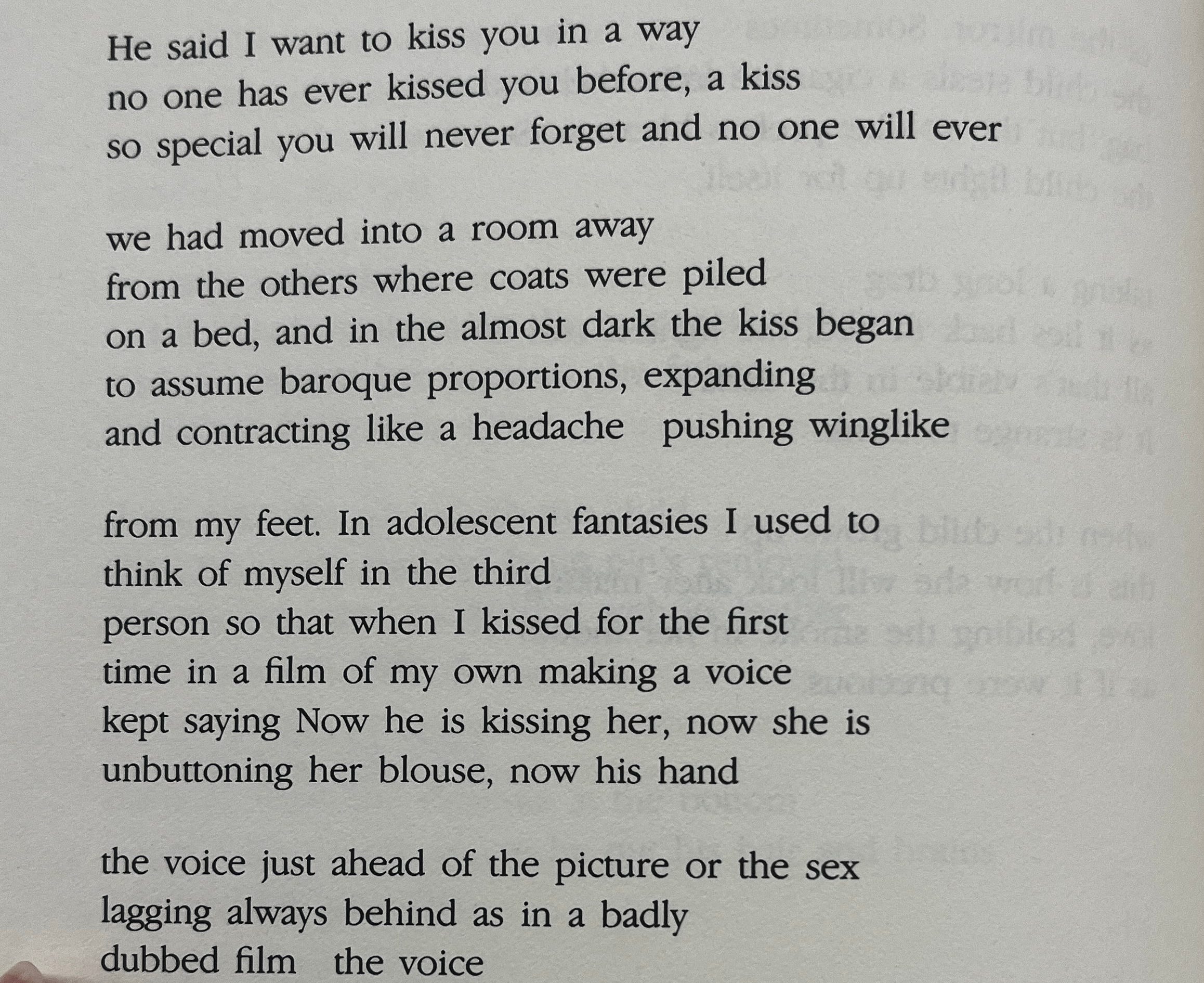
Rapture, Susan Mitchell — 1992 Poetry col.
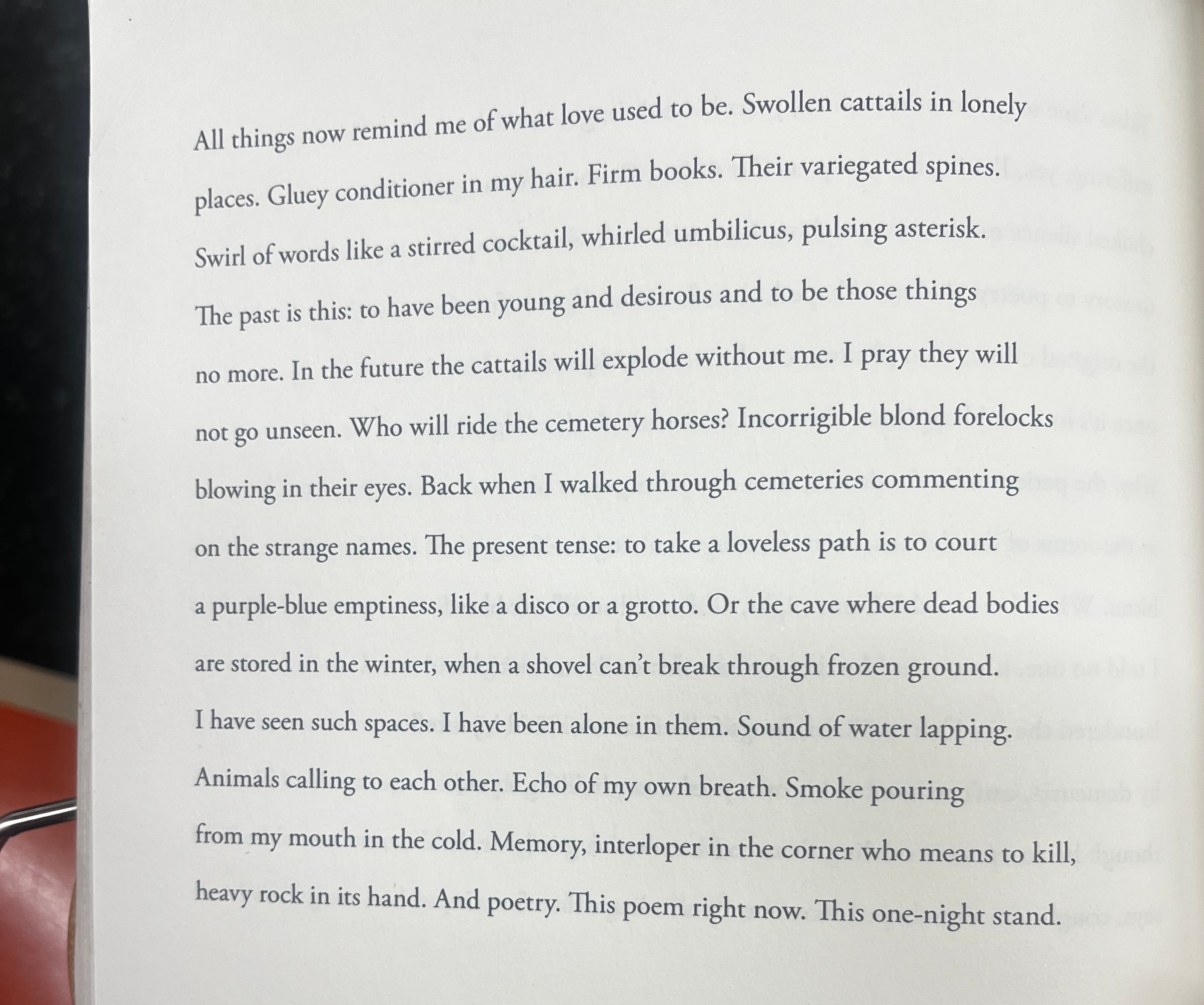
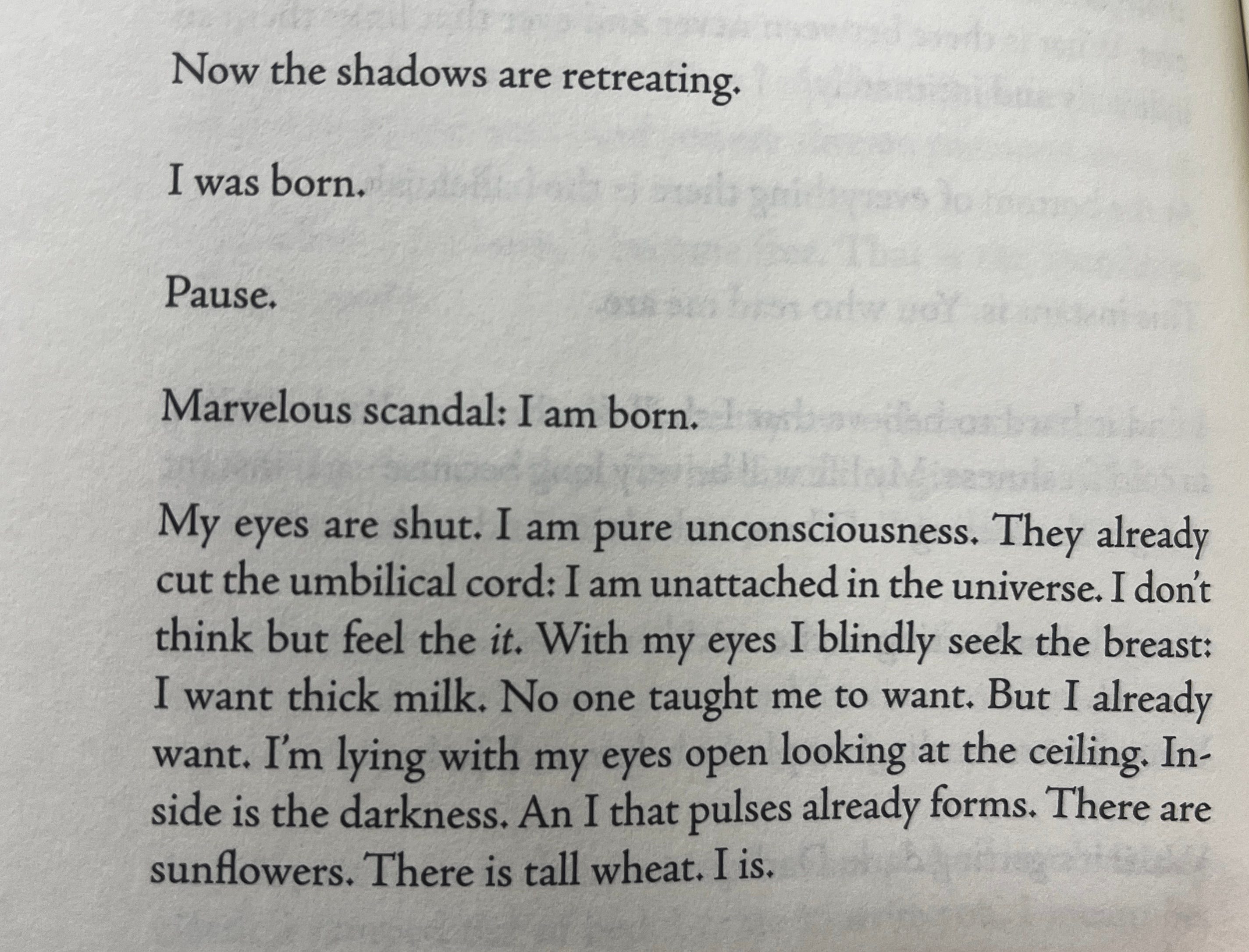
Borrowed from the school library after reading “The Kiss” and “Leaves that Grow Inward” in class, and haven’t returned since because I can’t stop going back in for more. Her maximalist textures and non-hierarchical narrative flows have probably had the biggest influence on my work last year. Now an all-time favorite collection and favorite poet.
fragment from”The Kiss,” which is long
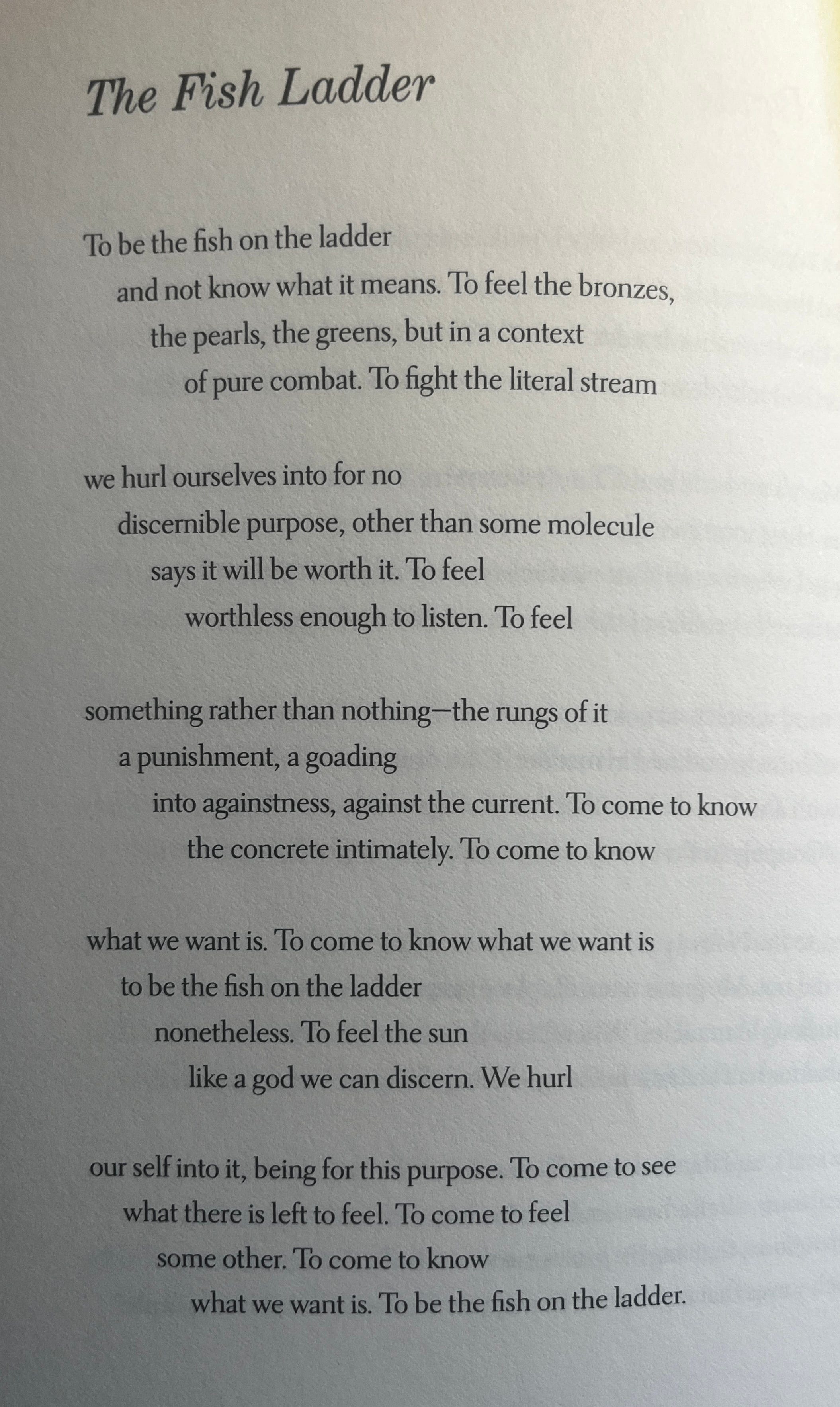
Phrasis, Wendy Xu — 2014 Poetry col.
Gifted second-hand from a talented and well-read classmate, became an unexpected touchstone contemporary collection for me. Works the fragment and the punctuation and floating, perfect enjambment like nothing else I’ve read. I’ve gone back to re-read this several times as a quick cure for mid-MFA malaise.
Cassandra at the Wedding, Dorothy Baker — 1962 Novel
Late-to-the-party audio loan from Libby, but an absolute knockout of a book and the best Twin literature there is—hits the nail on the head for difficulties to do with mirroring, delineation, separation. Admirable stunts in switching perspectives and adjusting voice, with an impressive amount of narrative momentum for a novel with mostly interior concerns. Manages to be funny and gorgeous and shattering in one.
Scaffolding, Lauren Elkin — 2024 Novel
Another book that made me wonder whether it was written just for me, in fact before I even read it. I was taken with LE’s work few years back when I read her nonfiction titles on subjects I was interested in then, like walking (Flaneuse) and dailiness (No. 91/92), and so I lit up when I saw she published her first novel to do with psychoanalysis and Lacanian theory and 1970s Paris and extramarital affairs and beautiful cruel coincidence2….I tried to manage my expectations but it sure pressed every button for me, and it was a pleasure to hear it all in LE’s sexysmooth voice.
Trouble in Mind, Lucie Brock-Broido — 2004 Poetry col.
Read in one sitting in the Poets House library as part of my LBB kick. Draws on another perfect and unique gimmick which is repurposing the discarded titles kept in Wallace Stevens’ Pieces of Paper notebook.2 She starts to play with more autobiographical content here while simultaneously getting wilder with her “ventriloquisms.”
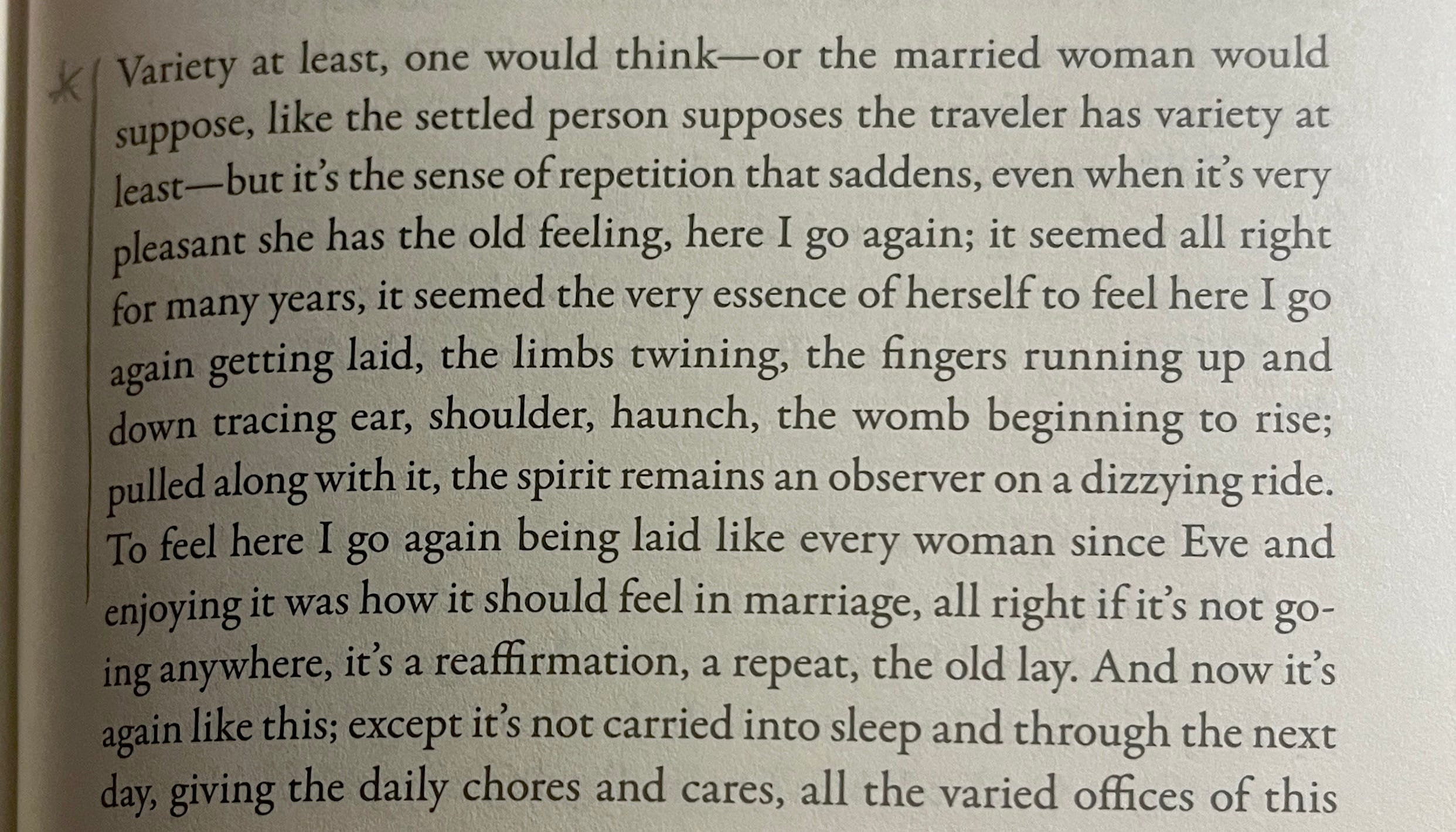
Divorcing, Susan Taubes — 1969 Novel
Libby audio loan (I think my first-ever) after a strong recommendation from my roommate, who also read it in the wake of a certain kind of divorce. The book, of course, is not just about relationship rupture but about subjecthood and psychoanalysis and sex and suicide and everything else I’m stuck on. I adored the stream-of-consciousness voice and wandering structure, too. Bought the paperback soon after finishing the audio so I could underline and copy passages into my notebook.
Something New Under the Sun, Alexandra Kleeman — 2021 Novel
At once more conventional and more fantastical in its sprawl than If You Too Could Have a Body Like Mine, proved to me that AK is a true keeper. Hysterical, lurid, suspenseful satire that absorbs the concerns of both the film industry and climate change and economic collapse, the perfect book to read not long after I visited Los Angeles for the first time.
The Cost of Living, Deborah Levy — 2018 Memoir
I remember that my earbuds died while listening to this on a long walk through the park, and I was so absorbed that I decided to just blast it out of my phone like any other Rude New Yorker. The best one-sitting read of the year, I’ve never once in six months stopped thinking about the ice-lolly scene.
Chelsea Girls, Eileen Myles — 1994 Novel
Influenced by the fact that it’s a major influence for a friend, wound up pretty much everything I’ve ever wanted out of memoir-style essays (even if it’s subtitled as a “novel”). A particular joy to hear read in Myles’ own tough New England accent, their rollicking stream-of-consciousness style that somehow feels “realer” than anything else I read last year. Hit the spot for my current fixation on 70s and 80s NYC. Made me want to live my life a little harder.
A Girl’s Story, Annie Ernaux — 2016 Memoir (trans. Strayer)
Libby audio loan on recommendation from a fellow Ernaux-head. Still ranks for me below The Years and Getting Lost in terms of the “life-changing” factor, but still I’d categorize it like that. Don’t be fooled by the “coming of age” or “shameful confession” schtick—this is one of the most profound books I’ve ever read about writing itself.
The World Keeps Ending, and the World Goes On, Franny Choi — 2022 Poetry col.
Loaned by a classmate at the end of ‘24, feels like I read this light years ago but left its mark as a refreshing newer poetry release. So brilliant on a technical level, delightful to read, cutting-edge, and relevant to our perpetual end-times, I’m surprised it didn’t earn more accolades besides being a finalist for Kingsley-Tufts (I mean, fine).
The Risk Involved, Jeffrey Utzinger — 2024 Essay col.
Gift from my father for Christmas and the first book of 2025, ranking high for a title you’ve never heard of since it was written by a relative. Lock me up for even including it here, but I was surprised by how much these essays hit for me—cousin Jeff not only has his prose chops, but the collection’s uniting obsession about the demands of American urban life and the pull towards “some other way” was epiphanic. I especially loved some of the lush, more experimental chapters, but as a whole these essays have enough humor and intrigue to make it my earnest recommendation to anyone.
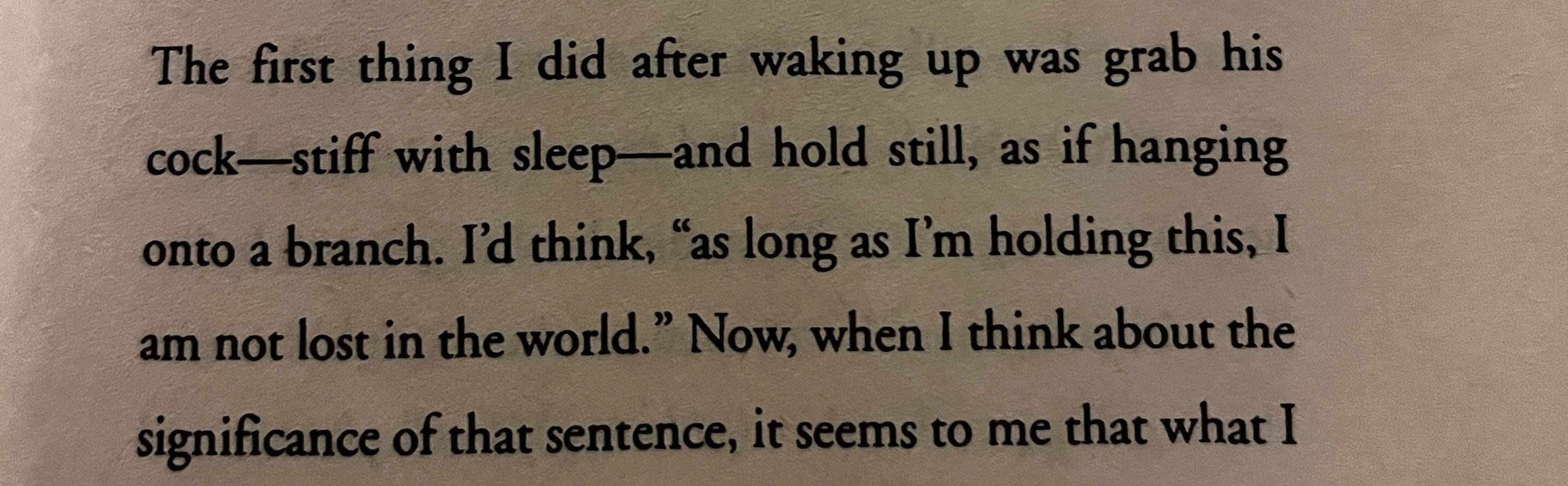
The Possession, Annie Ernaux — 2002 Memoir (trans. Strayer)
Bought new, read in one sitting, then arbitrarily inspired a conversation that precipitated the drastic life-changing-event I had the pleasure of experiencing last year. Thanks, Annie! Earns the prize for best opening lines3 (and along with #34 and I Love Dick, its place among the deranged-stalking syllabus).
Either/Or, Elif Batuman — 2022 Novel
I’d had a hardcover copy of EB’s sequel to The Idiot sitting incomplete on my shelf since 2022, so I made a spontaneous decision to audiobook-it while reorganizing my office’s scary file room. There’s a little shame in ranking what seems by comparison a mainstream, commercial, or frivolous book above what I know are better Works of Literature, but this was by far one of my most pleasurable reading experiences of 2025. Listening to EB again (and in her own voice!) gave me the same drug-rush of a long conversation with an old friend. Millenial hype aside, I still find her much funnier and smarter than other contemporary fiction writers writing about college-age romance…sorry Sally.
Foster, Claire Keegan — 2010 Novella
Libby audio loan following a recommendation, once again proving the supremacy of contemporary Irish literature. No doubt draws on inherently sentimental subject matter that I couldn’t resist crying over, but CK’s skill in subtlety and detail I think made it a more moving read.
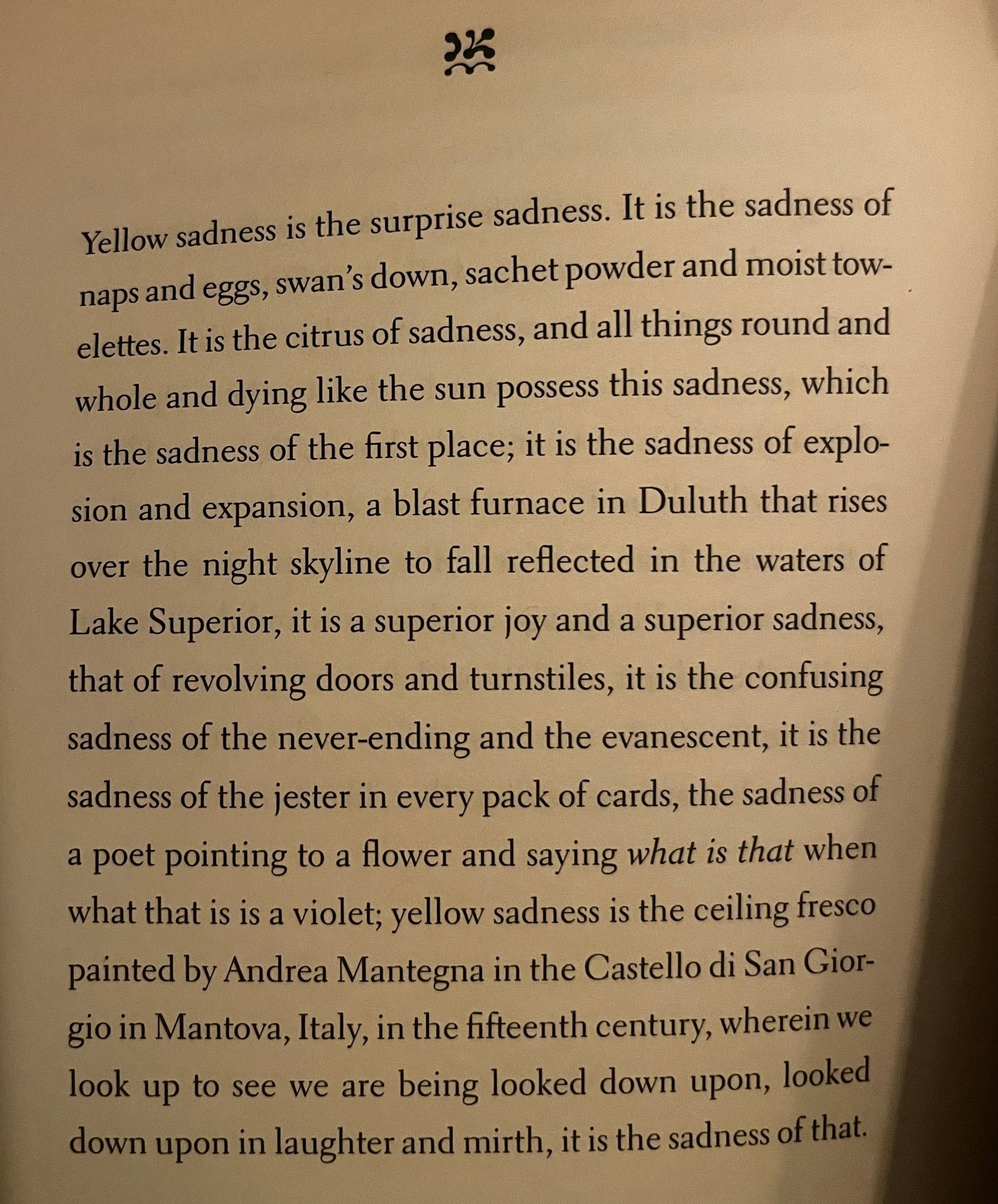
My Private Property, Mary Ruefle — 2016 Prose col.
Borrowed from the local library after spotting it on the shelf, having loved MR’s poem “After a rain.” The playful, quirky wit I loved in that poem carries through this collection of short prose pieces, and was most helpful through a depressing period of ‘25. I still think about colored sorrows and the triumphant cryalog (for some reason hit a lot better than #47’s treatment of the same exact topic).
Minor Detail, Adania Shibli — 2017 Novel (trans. Jaquette)
New buy for a book club meeting earlier in the year, and perhaps the most masterful novel I read in 2025 but also the most unpleasant reading experience. It’s important to note that while I think the book does appeal to abstract moral repulsion, the true-story abuses and their current implications referenced in Minor Detail exist more as a structure than in graphic depictions—what AS does instead is infuse both sections of the book with palpable and ambient dread that, for some reason or another, seeped into me so much that I wanted to throw up the entire time. I think everyone should read this book for political reasons, but writers, too, just for how well it operates on the level of craft.
The Return, Roberto Bolaño — 2010 Story col. (trans. Andrews)
Libby audio loan many months after I listened to a dedicated RB fan talk about him at a party for several hours...was skeptical at first of the bro-ishness factor, both in terms of fanbase (see #27) and the main subject matter (weapons, sports, porn). For sure the latter had my eyes glazing over often in the first half of the collection—which is by no means a criticism of RB’s juicy approach—but it wasn’t until I hit a story called “Cell Mates” that I was rapt and ready to convert. That I’m still thinking about this book tells me I’ll read more RB next year.
Bad Behavior, Mary Gaitskill — 1988 Story col.
Libby audio loan not long after finishing Veronica (#36), and I think stories are my preferred format for MG’s severe style of writing. Although I love urban settings and sex in fiction I’m not sure her seedy-nightlife-whorehouse-BDSM topics really speak to me as much as they might other people, but this was still a satisfying read for me. Noting that “Secretary” threw me in a good way (very different tone from the adaptation with Maggie Gyllenhaal).
The Plains, Gerald Murnane — 1982 Novel
What made me hesitate before reading this loan from a friend, more than it being an apparent Brodernist title, was the fact that it’s Australian literature. I have an abstract aversion to Australia (I can only blame the dark well of ignorance), and that this fever dream of a book is set in the inland plains(!?!?!?) did little to ameliorate my dread about that faraway land. That said, it did help my opinion of that land’s literature. Perhaps not the most enjoyable read, but yes, OK, GM is a genius.
Agua Viva, Clarice Lispector — 1973 Novel (trans. Tobler)
Recommended and loaned by a classmate, my first Lispector: intense, beautiful, like nothing I’ve read before, and also for whatever reason nightmarish for me. I recognize and salute CL as a fantastic mind but I often remember putting this book down mid-sentence while on the train because I could feel a panic attack escalating. Might be worth reading my next CL in a period of more settled nerves.
A Hunger, Lucie Brock-Broido — 1988 Poetry col.
Borrowed from the school library, my least favored of LBB’s four collections (also her first) but still with a dozen or so lines transcribed into my notebook while in a state of LBB-induced ecstasy. She never misses.
Alterations, Cori Winrock — 2025 Prose
Plucked off my host’s shelf in Bellingham, WA to read in one sitting while she slept to a reasonable west-coast hour. CW is a remarkably intelligent writer, even if I didn’t find the form revolutionary—like other lyric-essay-style books I’ve read, fragmented and drift-y personal trauma narrative patterned within research of loosely-corresponding topics. I admit the subject matter was difficult for me. I’m still thinking with fondness about her repetition of the phrase “dits and dahs,” which for me felt like Whitman’s “flashes and specks” but even stickier.
Jailbreak of Sparrows, Martin Espada — 2025 Poetry col.
Assigned to my class for the poet’s fall-semester visit, felt utter dread opening the first page and finding all of these chunky stanzas with lines almost reaching the end of the page. Then I flew through every last one of those substantial-ass poems because their content had all the momentum of good journalism. I wasn’t inspired as much by ME’s formal tactics and in fact found the “love song” segment of the book almost unreadable, but I think he’s a storytelling genius in the very admirable docupoetics/poetics-of-witness category. Excellent read I’d recommend even to (or especially to) a poetry-hater.
Chariot, Timothy Donnelly — 2023 Poetry col.
Bought new not long after seeing TD give a phenomenal reading at KGB (albeit not from this book, but even newer work). I’ve had a few teachers suggest I read him over the years and I’m glad I did at long last—was pleasantly surprised by the acerbic humor beneath denser lyric surfaces.
Ghost Money, Lynda Hull — 1986 Poetry col.
Borrowed from the library after reading LH’s masterpiece poem “Frugal Repasts,” which belongs to another collection, but was curious about this first book. I can guess that her work sharpened a little in later work, but I still enjoyed her scrappy urban textures and heady approach to the page.
Suite Vénitienne Sophie Calle — 1983 Art (trans. Penwarden, Hatfield, Barash)
A record of an artist’s one-of-a-kind stalking project in photographs and prose entries, loaned by a boy who affectionately stalked me. Gestures toward the abberational behavior capable of humans when seized by furious, curious desire, while drawing on a darker surveillance urge. Quick, delicious read, which made me admire SC’s work even more than I already did.
New and Selected Poems, Marie Howe — 2024 Poetry col.
Bought new ahead of MH’s Hunter College visit. Embarrassing to think how many times I read the poem “What The Living Do” out loud to myself last year, like it was my sad-and-alone-in-my-bedroom-at-night spell. Although MH avoids the ecstatic lyric turns and maximalist fluorishes I’m usually drawn to, she’s my God of syntax and I’ll spend the rest of my writing life trying to figure out how she creates such catchy rhythms with so few obvious sonic devices.
Veronica, Mary Gaitskill — 2024 Novel
Borrowed on audio from Libby, the first title available after a date recommended MG. I found she has brilliant moments of observation and a solid style—several “atmospheric” descriptions of New York just knocked me off my feet—but the slow and swampy effect of the narrative was cause for my ambivalence during the majority of my reading. It’s one of those “feel-icky” books in the vein of, say, Moshfegh, but I think MG gets away with it because, well, this is a story about the AIDS epidemic and its stigmas. The only book I read this in ‘25 that gave me a substantial cry.
Via, Claire DeVoogd — 2023 Poetry col.
Impulse-bought after seeing CDV read from it, then read on a long plane ride much later. A somewhat difficult lyric project, but I appreciated its scope, its strangeness, and the gist of “correspondence” with a long-dead poet (in this case, 12th-century Marie de France).
Happily, Lyn Hejinian — 2000 Poem
Was sent a free copy from a friend who knows I love LH. Another very tiny booklet of a long-lined, prose-y, disjointed poem, which I enjoyed reading but probably not as much as The Beginners or even Fall Creek.
Checked from the school library after learning he was my professor’s professor. The poems err on the traditional side, more bracing in terms of content than form, but a fond read overall.
Absences, James Tate — 1990 Poetry col.
Borrowed from one of my favorite living poets, who I know JT was a big influence on. I find his work often charming and clever but wasn’t as swept off my feet as other books of poetry I read last year.
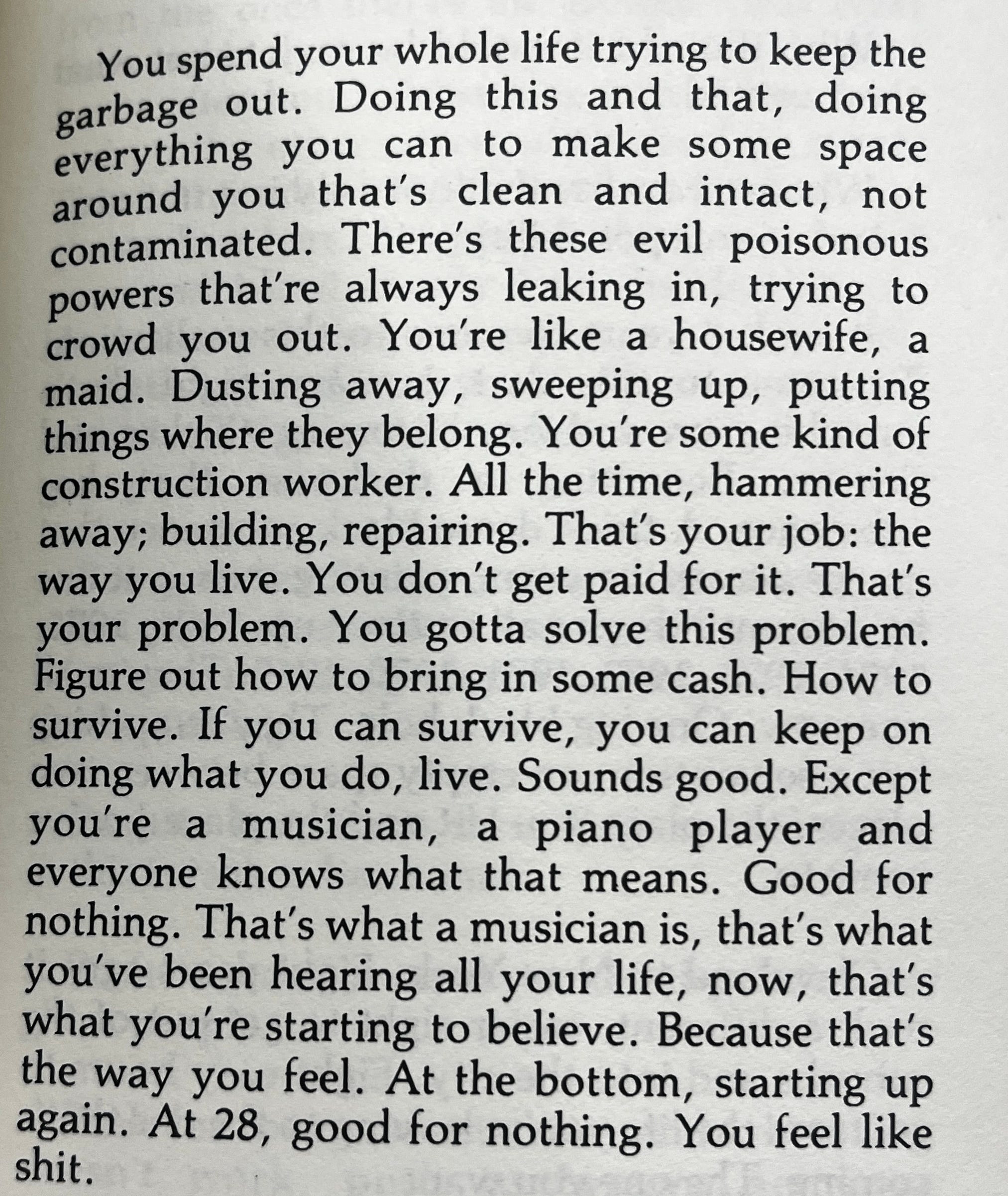
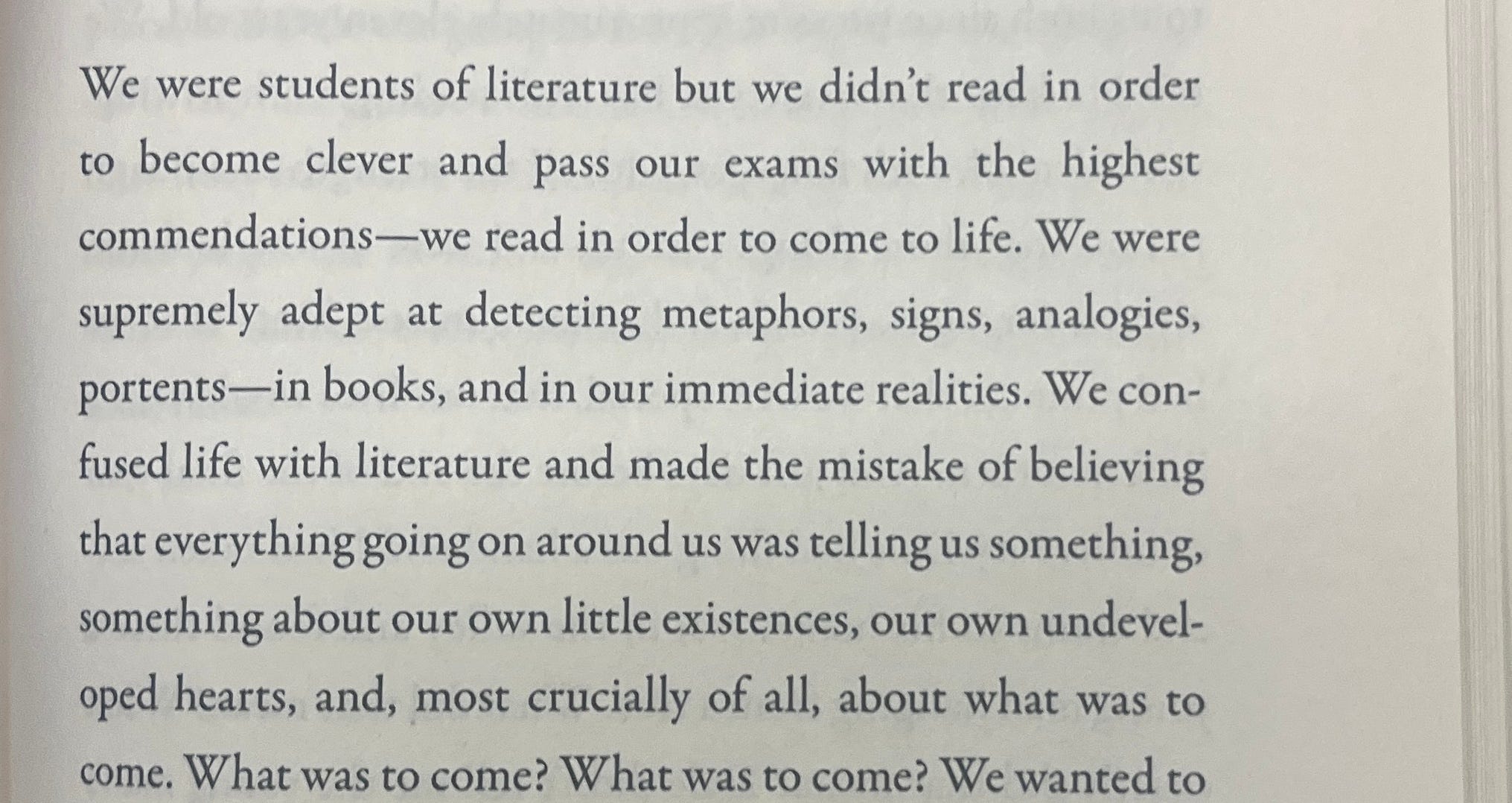
Checkout 19, Claire-Louise Bennett — 2021 Novel
Borrowed from my roommate, and my first CLB, which I suspect I would have appreciated more if I’d just read Pond first. Was surprised by how much I struggled through the first half (I actually put it down for over a month), due to what I think was skepticism over the stylistic choices and stuffy-sounding narrator, but came around once I caught onto the book’s brilliant “gimmick,” which is the story of a life told through literature. By the end I was copying whole passages into my journal, including this one which I think about all the time:
Small Things Like These, Claire Keegan — 2021 Novella
Libby audio loan shortly after finishing Foster. The writing here is just as fabulous, but the story itself ended up feeling a little too neat, canned, or feel-good relative to #22—almost designed like a classic Christmas fable about moral good, then packaged to be an Oprah’s book club pick. My opinion of it may have been tainted by its mention in this Metropolitan Review piece I read many months prior, but I don’t necessarily disagree that this book misses the “revolutionary” mark.
My Trade Is Mystery, Carl Phillips — 2022 Essay col.
Gifted by a dear poet friend, CP is not only one of my favorite poets but also penned my favorite craft essay of all time, “Muscularity and Eros.” I was so thrilled by his genius nuts-and-bolts, close-reading work that this book of essays about the broader practice of “being a writer” wound up feeling more diluted and obvious to me than I’d wished. Great writing of course but not life-changing for the closest thing I read to “self-help” this year.
Hothouse Bloom, Austyn Wohlers — 2025 Novel
Sent as an ARC ahead of an interview I conducted with AW, who I maintain is a brilliant and articulate person. I clicked so much with the book’s gist and spiritual thrust—an artist turns her back on the New York grind for a phony idea of a pastoral life managing her late grandfather’s orchard—but I found the attempt at “dreamlike” or “painterly” prose poorly executed and at great cost to what could have been a more solid narrative. Even as someone who most often appreciates atmospheric and slow-moving approaches, I grew irritated with the constant slew of figurative language (where in order to be described a thing is always “like” another thing, never itself) and felt like it was often sloppy or cheap. Even so, would definitely read AW’s next book.
Bought new for a book club meeting I ended up having to miss. Had high hopes for this book after hearing about The Wall, and I found the subsurface mother-son relationship interesting, but I couldn’t connect with the book much beyond feeling disturbed by the more central subject matter and disenchanted by the voice’s lack of affect.
Sturge Town, Kwame Dawes — 2024 Poetry col.
Bought new ahead of KD’s visit to Hunter earlier last year...not sure if I just wasn’t in the proper place to engage with this book, but I can’t really remember a detail despite listening to its author talk about it for over three hours.
All Fours, Miranda July — 2024 Novel
Libby audio loan after much anticipation. I found myself thinking a horrible thought about halfway through, which was: maybe I’d rather read about younger, sexier, scrappier lives than that of MJ’s narrator. I know aging into irrelevance is the book’s crux, but I bristled a bit against what feels like yet another wealthy and successful writer publishing autofiction about the agony of being middle-aged. I know I just wasn’t the right reader for it, ultimately, and I’ll say I did appreciate the plot’s overall absurdity, quirky smut, and the touches of wry humor. I don’t regret having read it but my disappointment during the experience knocked it far down the list.
The Sorrow Apartments, Andrea Cohen— 2024 Poetry col.
New buy ahead of class visit this fall. AC is one of the most charming and attractive poets I’ve had the pleasure of meeting, and she has an excellent presence on stage and in a classroom. The poems on the page weren’t for me. Most of them in this collection (quite short) read as quips or aphorisms with unconsidered line breaks, and only a few I found clever, the rest cheap and flimsy. Not necessarily a bad reminder, by contrast, of what I like and look for in poetry (complexity of thought, technical effort, good strangeness...).
I’ll finish off with mentioning two books I disliked so much I couldn’t finish, which were:
The Impudent Ones, Marguerite Duras — 1943 Novel (trans. Haskett)
It pains me to pan MD, who remains one of my favorite writers of all time, but this early novel of hers (the one which happened to be available to borrow from Libby as an audio) was a stuffy family drama totally lacking in the tonal genius she’d nail later in The Lover, The Easy Life, etc. This one was so dull I can’t even tell you a single thing that happened in over 50% I listened through before abandoning ship.
Dead Weight, Emmeline Clein — 2024 Essays
Had been looking forward to reading this since I first heard murmurs about it in 2022, but felt like a bust just a few chapters in. The writing style to my ear sounded almost identical to Leslie Jamison’s (EC’s teacher at Columbia’s MFA), whose repetitive and treacly syntactical habits already tend to grind my gears. Like Jamison, you get porny-feeling descriptions of female suffering (of the privileged variety) followed by weak analysis that meanders quickly to a chapter’s abrupt end. I felt offended by the initial pitting-of-bulimics-against-anorexics discourse, and what seemed to be shaping up as yet another scapegoating of Pop Culture as the leading cause of eating disorders, any reference to actual psychology completely eschewed. God forbid we engage with the internal complexity of such illnesses if there isn’t a cheap television portrayal to talk about, woooo. Unoriginal and useless, not even worth white-knuckling through the poorly-written vomit-smut to consider for a more serious critique.
And a handful of otherwise important books I read good chunks of but didn’t finish, or am still in the process of reading:
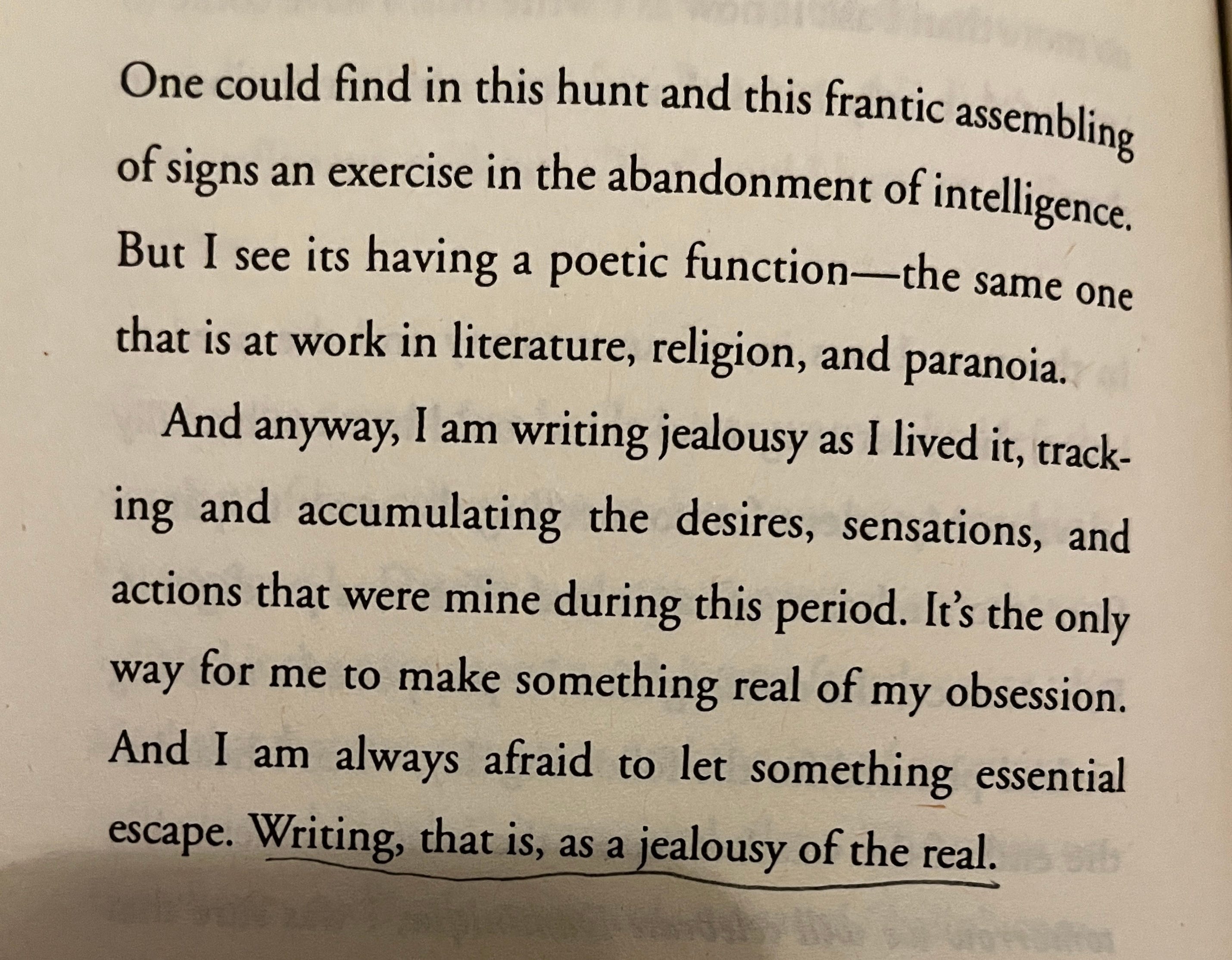
The Trial of Joan of Arc (the transcripts trans. Hobbins), The Flood Myth (Alan Dundes), The Desire of Mothers to Please Others in Letters (Bernadette Mayer), A Manual for Cleaning Women (Lucia Berlin), Garbage (A.R. Ammons), TheDescent of Alette (Alice Notley), Jealousy (Alain Robbe-Grillet), Pale Fire (Vladimir Nabokov), Illuminations (Walter Benjamin), The Constance De Jong Reader, and like a dumb fool in dumb love, Lacan’s Ecrits
And that’s it for my giddy slog of a #wrapped! This year I plan on fighting through my own shelf alphabetically and reading the unread hoards. I’ve also vowed to put down and get rid of anything that I’m not enjoying/chip away at my compulsion to finish books “just in case they get better” (rarely happens, waste of time). I welcome you comment or DM me about books anytime—advice, recs, fighting words, etc. Happy new year. ==


Such a rich selection. Thank you for sharing <3
i want to read all of these. Almost immediately i do and i will return once i so!!!!