
Postscript for a diary

I’m always tempted to call this thing I carry around a “diary,” rather than “journal” or “notebook,” because my interest in the habit of keeping one depends so much upon those lowbrow connotations. Legible as a daily record or not, “diary” at least feels suited to the embarrassment of the elliptical, emotional, or cryptic entries it shelters. Naturally a diary is a private thing. Why strip it of privacy and share it as if it were real writing, or safe for consumption by strangers?
No suprise that a professor in my program insisted her writing students keep a notebook—on the terms of Didion or Davis, something like a repository for ideas, or an incentive to keep writing constant and mobile, pocketed and accessible, so that it could happen everywhere without excuse, so that we would be so sensitive, open, and absorbent to the world and later when complaining of writers’ block we could have cold-storage material to draw from. “A productive feedback loop is established,” writes Davis at the top of her Thirty Recommendations for Good Writing Habits. “Through the habit of taking notes, you will inevitably come to observe more; observing more, you will have more to note down.”
Writing is talked about often, I feel, as if it were manufacturing—language as matter entering different states through processes of the mind—the reading material one component of initial force, and one’s life experiences (so often the transformative ones, the loves and losses and travels and trials) another, that style and content meld to create one product which is then hammered into good shape by processes of revision. Once that “product” is shared with other people it is less and less yours, and perhaps less and less “real” in each less-private iteration, even if it abandoned any corresponding reality the second it entered the realm of language.
I’ve been carrying around a notebook on and off since 2019. They never saw daily use, but several were filled nonetheless with stray phrases, project ideas, quotes, and plenty of incredibly mundane or incredibly melodramatic records of my life. I seldom endeavored to read them back. Only when I began writing with regularity on Substack in 2022 would I flip to a recent entry with the purpose of mining it for material. Posts that came from these I did call “diary-style”: shapeless texts wedged in between those with more substantial arguments. Still I attempted to select themes, write into them, and carve a vague narrative at least so that what I sent out on here resembled little of its source material, save for the italicized date at the beginning of the post.
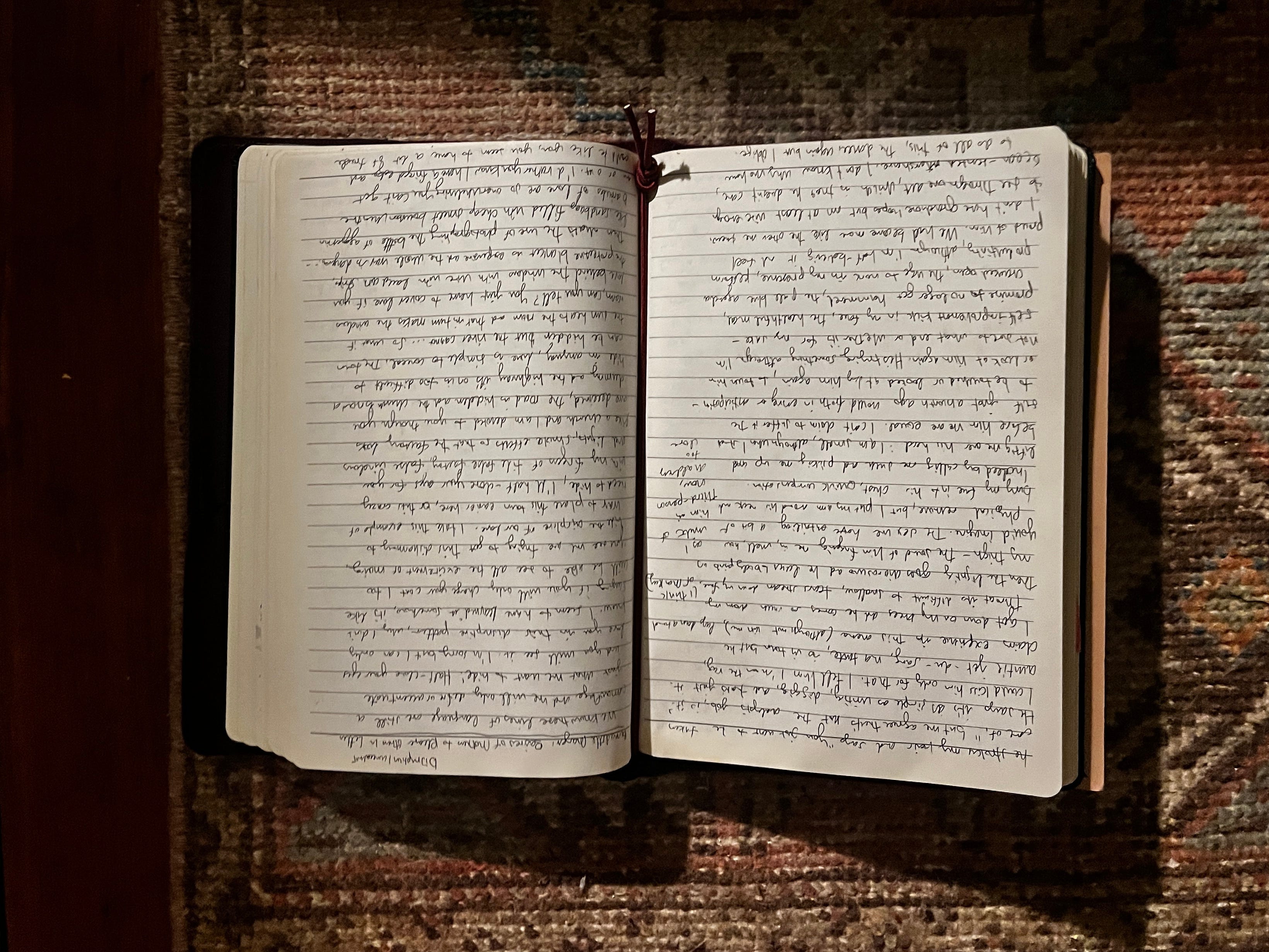
The last post I “developed” from of my diaries was Golden Mean. One handwritten entry noted sequences of images and fragments of dialogue from earlier on the January night I wrote it, but lacks context or propulsion or anything I’d consider interesting writing:
My contact lenses are fogged: so is the world. Chinatown in the rain, lit neon, wide street in wind, early dark, open mouth of the bridge: precipice. Wayne does the funny voices from It’s A Wonderful Life. Speak of the preordained, lack of real control: he can read into my soul through my eyes. I don’t admit that I can always feel them being soulful as I look at people in a state like this. We riff about meeting again — “Oh, did you ever move out of Clinton Hill?” “Yes, yes I did, I live in —” but I can’t answer, the future is blind. Storm of progress and I am the fogged eye. At Chinatown Soup, Michelle sees it: high priestess in the middle (that’s you) — king of swords (big personality, something going on with this guy), temperance and justice: it’s not fair. You’ve had to compromise. Sometimes the first thing out of the mouth feels the least contrived. I pet the fur stole. “Wait until August,” she says. “You’ll feel yourself again.”
Few original lines survive in the Substack version. Instead I’d called upon my faulty cache to write out the full scene, flesh it out in mostly clean and grammatically complete sentences.
Another time I tried to access my memory of a particular place at a particular time for a project, and too wanted to mine it from sentences that had long ago stopped moving across the page. I dug up the diary I’d kept in summer of 2020 and attempted to transcribe its entries word-for-word directly into the poem. My approach to this tall, skinny thing (inspired by a poet named A.R. Ammons, who I was reading at the time) was durational and messy and involved a degree of “automatic” or associative writing. It felt more appropriate to leave nothing out in this first iteration, and to alter the text only slightly by putting it in lines. Of course, a poem did not demand the logical contexts or syntaxes I’d usually impose on an essay-ified entry.
Then, later, that same poetry professor had her students turn in one typed-up page of our notebooks per week. My habit had slowed at the beginning of that semester, so I went back and transcribed everything in a diary I’d begun in May of 2024. The entries were more scattershot, then, mostly dream impressions and sentence fragments; but by August I was spending long train rides writing about what was going on in my life, embellishing those fresh scenes with moods and images, getting a control fix by narrativizing them. Over time, something about this “raw material” began to charm me. Did this slop, now faithfully transcribed into a digital document, have any merit on its own? What would it be to treat the entries as one would a finished product, at least worthy of reading?
==
Around this time I was also cozying up to the concept of a talking cure. I’d devoted a couple of years to overcompensating for a “black hole of a person” honorific I’d received from someone in college, which is to say I’d become very private, and believed my mumness amounted to good manners. I’d vowed to never talk about myself for longer than five minutes with anyone I wasn’t paying a fee. It took (of course) messing up a recreational dose of psilocybin in 2023 for me to divulge a very important sequence of events in my life to some co-trippers. The globular ceiling lights in my living room swung on their fixtures and threw laggy shadows across the walls; I found myself recounting the whole thing as if I was remembering it for the first time. Like waking up from a coma, that story felt epiphanic, almost removed from myself: these difficult and warped dramas, which, crammed so deep for a few years, had never before found any confidant, and therefore resisted any real emotional scrutiny. I spoke with a generous and psychotic smile on my face. They listened. The air came in. Not so bad.
One year later, I felt comfortable enough with one of those confidants to bring up a hypothetical life-changing decision I’d begun to privately torture myself over. She gave me a good piece of advice: talk to everyone about this. The more you attempt to articulate this out loud, the more you’ll understand how you actually even feel. Duh. My following that advice—the radical concept of opening up to other people—was more life-changing than the decision ever was.
My increasing fixation on old-fashioned psychoanalysis and its eccentric accompanying theories had, by last year, made me pay more attention to the quirks of expression itself. Embedded within the practice of a patient lying down and letting the blood rush to their head and blabbing nonsense was the analyst’s ambition to free them from the “chains of narrative.” Two rules: nothing should be omitted and nothing should be systematized. Analysis presumed significant all the dross of mental life. This was like parataxis—in grammar, the stream of one after another, without words to indicate coordination or subordination—when applied to the psyche. It wasn’t the patient’s prefab sob story that told the analyst anything so much as their dream scenarios, presentiments, daydreams, confused or lucid delusions, slips of the tongue and bungled actions. And a step further: it didn’t matter what the patient was even saying but how they were saying it. The way words escaping their lips were chosen and arranged, unconsciously, in real time.
My diary entries remained useful to me as records of my life, sure, but I also found proof in them of my granular writing instincts. I was surprised by how those sentences wound up sounding when typed into a document—much more boisterous and complicated than I’d realized, indicative of influence from writers I liked but whose habits I couldn’t seem to incorporate when I tried. But those sentences created a picture of how I wrote without a presumed reader in mind, how my thoughts proceeded when left unchecked in a passing moment, so often sloppy and riddled with errors, disposed to the chaos of run-ons and non-sequiturs and sonic associations as I let not-quite-right but readily available words bounce and echo between my hurried brain and the page. I could observe not so much the proximate events or immediate surroundings to the time of writing, but how I chose to put them into language: the knee-jerk syntax, diction, metaphor, rhyme. As I typed them up from the remove of months or weeks, the scribbling self gave off the impression of a deranged stranger with a voice uncannily closer to my own than anything I’d managed before.
If speech is Symptom, diary is Text. I’d overlooked thoughtless babble and thoughtless scribble as the precious things they were in favor of more measured approaches to expression. Beyond Modernist prose styles that emulated stream-of-consciousness, I was suddenly interested in reading writing that was stream-of-consciousness, published in huge tomes like Bernadette Mayer’s The Desires of Mothers to Please Others in Letters. I grew more partial to what sounded like the erratic cadences of the mind, difficult or dense as they could be. It felt compelling that the most natural method of writing often resulted in the most uncanny, surreal, or absurd outcome; I became curious about the tension between the writer’s instinct and the reader’s sense, or what could pass between them. And then I arrived at the thought: hell, what if I just posted all these diary transcripts to Substack as if they were worthy as essays?
==
Davis instructs her novices to “revise notes constantly—try to develop the ability to read them as though you had never seen them before, to see how well they communicate,” and I’ll admit to making many minute alterations as the entries were converted from page to doc to draft. In the Substack stage, I removed dates and redacted proper nouns of people and places, leaving the entries somewhat opaque and coded, even sanitized. The practice of visiting the entries a third time and anonymizing them for the Internet offered another subtle chemical process: like my tripping confessional, I relived these things from an omniscient vantage, became aware of my own grip of narrative control, and most importantly, felt the gaps between the writing and my real, just-past experiences.
That element of the project implicated other writing-related concerns of mine. In self-published diary entries, layers of artifice seem more densely pasted together than in autofiction, and more difficult to distinguish in the overall feint of authenticity made by language. Yet the practice generates writing no less abstracted from reality, no less cleverly mendacious than any elaborate performance of “keeping it real,” any hashtag-no-filter object. It forced me, too, to think about the role of an imaginary interlocutor in private versus public forms of the diary—what happens when the self-address of sealed pages shifts to a broader, more diffuse audience on the Internet.
Last June, I copied out the following from Lacan’s early essay on psychoanalysis, “Beyond the Reality Principle”:
Let us pursue our outline of analytic experience: the listener is thus situated in it as an interlocutor. The subject solicits him to assume this role, implicitly at first, but soon explicitly. Remaining silent nevertheless, and hiding everything including even his facial expressions (which are, moreover, barely noticed in him), the psychoanalyst patiently refuses to play this role. Is there not a threshold at which such an attitude must bring the subject’s monologue to a halt? If the subject continues, it is by virtue of the law of analytic experience; but is he still addressing the listener who is truly present or is he instead addressing some other now, someone who is imaginary but realer still: the phantom of a memory, witness of his solitude, statue of his duty, or messenger of his fate?
Someone who is imaginary but realer still: the impassive analyst, the impassive page, the impassive Internet. Who am I even talking to? You remember that the birthplace of narrative was dialogue, that the gravitational force of an imagined Other bends the writing into a shape resembling intimacy. I won’t claim to have an addressee, but this late-January entry that I’d adapted for “Golden Mean” could be a coda for the whole diary:
Dreamed of [X]. Different this time, more shameful—but all my entries are the same and about the same thing. I walk alone down my old timeloop cobblestone and think: “Where are you? Where are you?” Which I have probably hundreds of times before. I wait for the city to heave, purge, split to reveal him when I want it to (partially), it never does, I am powerless and endeared to my powerlessness. This place is a daily lottery, shake of the wrist and clack of sensory dice. There is no organized meaning but an ambiance—however false—of “meaning.” I don’t know why I’m writing so messily when I’m completely sober, maybe my hands are still cold. I need to remind myself that this is not a diary.
“This is not a diary,” I wrote idiotically in my diary. “X will never happen,” I’d implied, and X idiotically happened. That washy throughline, which was an ellipitical revolution around this one mysterious desire, would never have registered to me if I hadn’t stumbled into this form of reflexive study that was typing up my diaries. Certain events of last year would have held much less significance for me if I hadn’t been so consciously aware of my writing towards them. Meaning would have remained “ambient” at best and never “organized” in this bizarre, uncanny narrative structure I’d crafted by accident in daily record. The diary would have remained an endearingly powerless object.
There were other times I replaced the human, gendered pronoun with “it” when converting entries, partially out of embarrassment for the referent and partially because I understood that the subject had outgrown the individual—his initialized name was only a stand-in for a greater force between myself and the world. This is to say that the entries weren’t so much an address to the actual person denoted by [X], but an address to my surrounding reality as it proceeded through time, which encompassed phantom, witness, statue, and messenger at once. The address took the form of entreaty: give me events through which to invent meaning.
With the distance of a little time I’ve accepted that coincidences between the diaries and reality have nothing to do with miracle, magic, nor manifestation; no God or nor fate involved, and this book is not a grimoire to be applied to my ultimately pedestrian life. But it is a line hooked up to the far-off dimension that is, I guess, my unconscious. Proof of language as a necessary aperture, the means of opening up not only to other people, but to myself, and then the world. Proof of life, too. ==